 blog
blog
Low Down Payment Used Cars: 2026 Financing Guide
Table of Contents
- Low Down Payment Used Cars: What You Actually Need to Know
- How Much Down Payment Do You Need on a Used Car?
- Bad Credit Auto Loans: Down Payment Strategies That Work
- ITIN Auto Loans: Financing Without a Social Security Number
- How to Estimate Monthly Payments and Total Cost on a Used Car
- Dealership vs. Private Seller: Where Low Down Payment Deals Are Better
- Fees, Taxes, and Trade-In Value: What to Bring to the Table
- Conclusion
- Frequently Asked Questions
Last Updated: September 27, 2026
Low Down Payment Used Cars: What You Actually Need to Know
A low down payment used cars purchase usually means putting down less than 10% of the sticker price. Days Auto Sales works with shoppers across the Inland Empire, Orange County, and Los Angeles who need that flexibility. But a low down payment changes your monthly payment, your APR, and sometimes your loan term.
How Much Down Payment Do You Need on a Used Car?
The conventional target is 10% to 20% of the purchase price, but that assumes average credit and a conventional auto loan. Buyers with damaged credit, no credit history, or an ITIN often need more cash down, while some dealership financing programs work with far less.
The 10-20% Rule and When It Doesn't Apply
A larger down payment shrinks your principal balance, lowering both your monthly payment and total interest. It also reduces the lender's risk, which is why a bigger cash down often earns a lower interest rate.
The rule stops applying in a few common situations:
- You're financing a budget-friendly vehicle under roughly $15,000, where a 20% down payment is a large share of your savings
- You have strong credit and can qualify for a low APR without much cash down
- You're buying from a private seller, where financing options are limited and the seller usually wants full payment
- You need reliable transportation now and draining your emergency savings would create a bigger problem
Down Payment Requirements by Credit Tier
Lenders sort applicants into rough tiers, and each tier carries different expectations for cash down.
| Credit Tier | Typical Down Payment Expectation | What It Means for You |
|---|---|---|
| Excellent (720+) | 0-10% | Best APR, most flexibility |
| Good (660-719) | 10% | Standard terms, competitive rates |
| Fair (600-659) | 10-15% | Higher APR, some lenders tighten terms |
| Poor (below 600) | 15-20%+ | Larger cash down offsets risk |
| No credit history | Varies | Down payment and income proof carry more weight |
| ITIN applicant | Varies | Documentation and cash down matter more than a score |
Bad Credit Auto Loans: Down Payment Strategies That Work
Bad credit auto loans hinge on one idea: when your credit score can't reassure the lender, your cash down and income documentation have to. A larger down payment offsets a low score fastest because it reduces how much the lender stands to lose.
Bad Credit vs. No Credit: Different Problems, Different Solutions
Bad credit means you have a history, late payments, collections, or a repossession. Lenders see a pattern and price the risk into your rate. The fix is time plus a larger cash down.
How to Lower Your Down Payment When Your Credit Is Damaged
A few moves genuinely help:
- Add a co-buyer with stronger credit. Their score can carry more weight than your cash down.
- Shop the vehicle, not just the loan. A lower-priced, reliable model needs less cash down to hit the same approval threshold.
- Show stable income. Consistent pay stubs and a steady address history reduce perceived risk.
- Put more down if you can. Even a few hundred extra dollars can shift which tier you land in.
ITIN Auto Loans: Financing Without a Social Security Number
ITIN auto loans let buyers without a Social Security Number finance a vehicle using an Individual Taxpayer Identification Number. The process works much like a standard auto loan, but documentation differs and lenders weigh income proof and cash down more heavily.
How to Estimate Monthly Payments and Total Cost on a Used Car
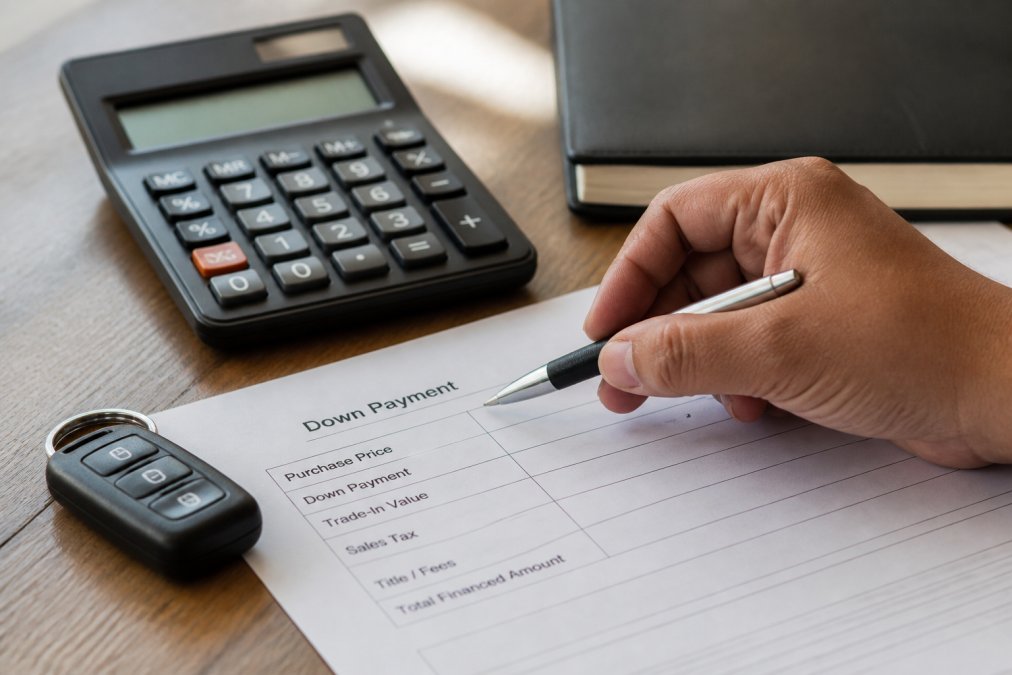
Your monthly payment is set by three numbers: the amount financed, the APR, and the loan term. The amount financed is the purchase price minus your down payment and any trade-in equity.
Monthly Payment Math: APR, Loan Term, and Principal Balance
A longer loan term lowers your monthly payment but raises total interest; a shorter term does the opposite. That's the trade-off most buyers miss when they focus only on the monthly number.
Here's the practical version:
- Amount financed = purchase price − down payment − trade-in value
- Monthly payment rises when the APR rises, the term shortens, or the amount financed grows
- Total interest rises when the APR rises or the term lengthens
Total Cost of Ownership: What Competitors Don't Tell You
The down payment is the smallest part of what you'll spend. Total cost of ownership includes sales tax, documentation fee, registration, insurance, fuel, maintenance, and repairs over the years you own the car.
| Cost Category | Paid Upfront | Paid Monthly | Paid Over Time |
|---|---|---|---|
| Down payment | Yes | No | No |
| Sales tax and documentation fee | Usually | Sometimes rolled in | No |
| Monthly payment | No | Yes | Until loan ends |
| Insurance | No | Yes | Ongoing |
| Fuel and maintenance | No | Yes | Ongoing |
| Repairs | No | No | As needed |
A Quick Way to Stress-Test the Deal
Before you commit, ask three questions. Can I cover the monthly payment plus insurance plus fuel without touching my emergency fund? If a $700 repair hits next month, can I absorb it? Is the loan term short enough that I won't still be paying when the car is ten years old? If any answer is no, the down payment isn't the problem, the deal is.
Dealership vs. Private Seller: Where Low Down Payment Deals Are Better
Dealership financing is the better route when you need a low down payment, because dealers arrange installment loans and work with multiple lenders. A private seller almost always wants the full price at once, so you'd need your own auto loan through a bank or credit union first.
A few practical differences:
- Dealership: financing on site, trade-in credit applied directly, documentation handled for you
- Private seller: you arrange the loan, you handle the paperwork, no trade-in credit
- Both: get a vehicle history report and an independent inspection
How Private-Party Financing Actually Works
When you buy from a private seller with a loan, the typical flow looks like this:
- Get pre-approved with your bank or credit union before you shop. The letter states a maximum amount and a rate, usually valid for 30 to 60 days.
- Find the car and agree on a price with the seller. Make the offer contingent on financing and a mechanic's inspection.
- Give the lender the vehicle details, year, make, model, mileage, VIN. The lender checks the vehicle's value against its loan-to-value limits.
- The lender issues a check made out to you, the seller, or both, depending on the institution. Some lenders require the seller to be present at a branch to sign the title over.
- You complete the title transfer at your state's motor vehicle office, pay sales tax and registration, and add the lender as lienholder on the title.
Negotiating a Lower Down Payment: Scripts and Tactics
The down payment is negotiable in many dealership transactions, especially when the dealer arranges financing in-house. Here's how to approach it.
Which Route Fits Your Situation
Choose the dealership when you need flexible financing, want to use a trade-in as part of your down payment, have damaged or thin credit, or are using an ITIN. Choose a private seller when you have cash or a pre-approved loan, want a lower price, and can handle the paperwork and inspection yourself. The right answer depends on whether your bottleneck is cash or credit.
Fees, Taxes, and Trade-In Value: What to Bring to the Table
Sales tax, the documentation fee, and registration all add to what you pay, and none disappear because your down payment is small. Ask for an itemized breakdown before you sign.
Conclusion
The hardest part of buying a used car with a low down payment isn't finding the car, it's finding a lender who looks past your credit score, ITIN status, or a rough financial stretch and focuses on what you can afford. Days Auto Sales welcomes bad credit, no credit, and ITIN applicants, with over 1,000 pre-owned vehicles and service by appointment for a personalized walkthrough.
Frequently Asked Questions
What is a reasonable down payment on a used car with bad credit?
A reasonable down payment on a used car with bad credit is 10% to 20% of the purchase price, but some lenders accept less. A larger down payment lowers your monthly payment, reduces the amount financed, and can offset a higher interest rate. If you have bad credit, aim for at least 10% down and ask the dealer about pre-approval before you visit so you know your actual budget.
Can I get ITIN auto loans without a Social Security Number?
Yes. ITIN auto loans are available from dealerships that work with lenders familiar with Individual Taxpayer Identification Numbers. You will typically need your ITIN, a valid government-issued ID, proof of income, proof of address, and a down payment. Not every dealer offers this, so call ahead and confirm the finance department handles ITIN files before you drive out. Days Auto Sales works with ITIN applicants regularly.
Does a larger down payment help with bad credit auto loans?
A larger down payment helps with bad credit auto loans because it reduces the lender's risk. When you put more cash down, the loan-to-value ratio drops, which can lead to a lower APR and a shorter loan term. It also lowers your monthly payment and total interest paid. Even an extra $500 or $1,000 down can change your approval odds and terms, especially if your credit score is below 600.
How can I buy a car with little to no money down?
Buying with little to no money down requires a combination of factors: a steady income, a trade-in with equity, a co-signer with good credit, or a dealership that works with lenders offering low down payment programs. Some lenders allow $0 down for qualified buyers, but you will still owe sales tax, documentation fees, and registration. Ask about down payment assistance programs and always compare the total cost, not just the monthly payment.